
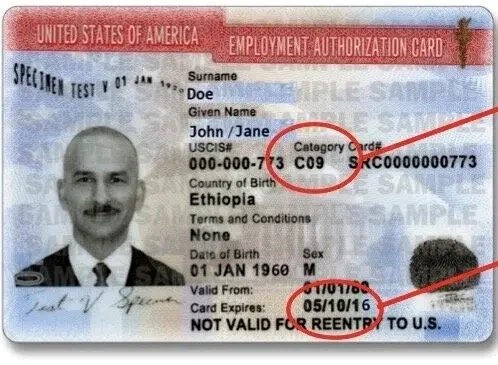
On the 14th, the U.S. Department of Homeland Security (DHS) announced a final rule that formalizes the elimination of the automatic 540-day extension for certain Employment Authorization Document (EAD) renewals. For Chinese immigrants who rely on these work permits to work legally, this means that even if they file for renewal on time, they could still face an interruption in their employment due to processing delays.
This restriction effectively went into effect on October 30, 2025; the latest announcement does not introduce new limitations but rather codifies existing temporary measures into a final rule.
One Chinese immigrant, currently awaiting a decision on his asylum case, supports his family of three by driving for Uber. His work permit is set to expire in March 2027. With the government having previously removed the automatic extension provision for certain EAD renewals—a policy now made permanent—he is increasingly anxious about his ability to continue working.
He noted that even if he submits his renewal application well in advance, if U.S. Citizenship and Immigration Services (USCIS) fails to complete the review before his current permit expires, he could be forced to stop driving, leading to a loss of household income. As the March 2027 expiration date approaches, the uncertainty surrounding the renewal process has placed him under significant stress.
According to the Federal Register, eligible immigrants previously benefited from an automatic extension of their work authorization—for up to 540 days—if they filed a timely renewal application before their existing permit expired. This arrangement was originally intended to mitigate the impact of the backlog at USCIS and prevent applicants from losing their jobs due to administrative delays.
However, as of October 30, 2025, certain EAD renewal applications are no longer eligible for this protection. The newly finalized rule applies to various immigration categories, several of which are particularly relevant to the Chinese community:
One such category is “C08,” which pertains to immigrants whose asylum applications are still pending. Although these individuals have not yet been granted asylum, they may apply for a work permit once they meet specific regulatory requirements. Next is the C09 category, which includes individuals who have filed an I-485 application for adjustment of status and are awaiting the approval of their green card—a group that encompasses some applicants seeking permanent residency through family-based or employment-based immigration pathways.
The third category is C26, which primarily concerns eligible H-4 visa holders—specifically, the spouses of certain H-1B specialty occupation visa holders.
It is important to note that the new regulations will not immediately invalidate existing, unexpired employment authorization documents (EADs). For those who filed timely renewal applications before October 30, 2025, and qualified for an automatic extension under the previous rules, their existing protections will generally not be retroactively revoked by these new provisions.
For asylum applicants, another change involves a reduction in the validity period of EADs. Starting December 5, 2025, U.S. Citizenship and Immigration Services (USCIS) will shorten the maximum validity period for certain newly issued EADs—including those in the C08 category—from five years to 18 months. EADs with a five-year validity period that have already been issued will generally remain valid until their stated expiration date; they will not be automatically shortened.
This means that some asylum applicants will not only need to renew their EADs more frequently, but they will also lose the previous protection that allowed for an automatic extension of up to 540 days while a renewal application was pending. If USCIS fails to complete its review in a timely manner, an individual’s ability to work and earn an income could be negatively affected.
The Department of Homeland Security (DHS) states that eliminating these automatic extensions will help strengthen identity and background checks, ensuring that individuals continue to meet the requirements for employment authorization. However, immigrant advocacy groups express concern that, given the ongoing backlog of cases, this measure could force immigrants who filed for renewals on time to stop working due to administrative delays.